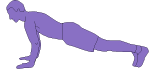
11-20 Push Ups
| If you did 11-20 push ups in the test | |||
| Day 1 60 seconds (or more) between sets |
Day 4 60 seconds (or more) between sets |
||
| set 1 | 8 | set 1 | 12 |
| set 2 | 9 | set 2 | 14 |
| set 3 | 7 | set 3 | 10 |
| set 4 | 7 | set 4 | 10 |
| set 5 | max (minimum 8) | set 5 | max (minimum 15) |
| Minimum 1 day break | Minimum 1 day break | ||
| Day 2 90 seconds (or more) between sets |
Day 5 90 seconds (or more) between sets |
||
| set 1 | 9 | set 1 | 13 |
| set 2 | 10 | set 2 | 15 |
| set 3 | 8 | set 3 | 11 |
| set 4 | 8 | set 4 | 11 |
| set 5 | max (minimum 10) | set 5 | max (minimum 17) |
| Minimum 1 day break | Minimum 1 day break | ||
| Day 3 120 seconds (or more) between sets |
Day 6 120 seconds (or more) between sets |
||
| set 1 | 11 | set 1 | 14 |
| set 2 | 13 | set 2 | 16 |
| set 3 | 9 | set 3 | 13 |
| set 4 | 9 | set 4 | 13 |
| set 5 | max (minimum 13) | set 5 | max (minimum 19) |
| Minimum 2 day break | Minimum 2 day break | ||
Why One Exercise Does So Much
Here is the strange thing about the push-up: it asks for no equipment, no gym membership, and roughly two square meters of floor, yet it can keep challenging you for years. Drop down on a hotel carpet, a park bench, or your kitchen tiles and you have everything you need. Few movements travel this well, and even fewer keep giving you somewhere new to go once the basics feel easy.
Start with what your hands are doing. Set them shoulder-width and you get the classic push-up, chest and triceps sharing the work. Spread them wider and the chest takes over; bring them close, almost under your sternum, and the triceps start complaining first. Same movement, three different emphases, decided entirely by where you plant your palms.
Want it harder? Prop your feet on a chair. Suddenly the angle shifts to your upper chest and shoulders, and reps that felt routine turn honest again. Add a clap at the top and you have crossed into plyometrics, training the fast, explosive contractions that sprinters and boxers live on. There is real range here, from patient strength work to sharp, powerful bursts.
It scales the other way just as gracefully. Newer to training? Drop to your knees, or push against a wall or countertop, and you take load off until the movement fits you rather than defeats you. On the far end sits the one-arm push-up, which demands the kind of strength and balance that takes most people months, sometimes years, to earn. Same exercise, wildly different destinations.
That reach is why push-ups show up nearly everywhere people train. Athletes bend the variations toward the demands of their sport, and physiotherapists sometimes fold gentle versions into recovery work when a qualified professional is guiding it. You can chase raw endurance with high reps, or brute strength with slow, weighted grinders. One movement, an entire spectrum of goals, and none of it needs more than the floor under you.