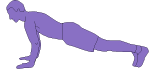
26-30 Push Ups
| If you did 26-30 push ups in the test | |||
| Day 1 60 seconds (or more) between sets |
Day 4 60 seconds (or more) between sets |
||
| set 1 | 14 | set 1 | 21 |
| set 2 | 18 | set 2 | 25 |
| set 3 | 14 | set 3 | 21 |
| set 4 | 14 | set 4 | 21 |
| set 5 | max (minimum 20) | set 5 | max (minimum 27) |
| Minimum 1 day break | Minimum 1 day break | ||
| Day 2 90 seconds (or more) between sets |
Day 5 90 seconds (or more) between sets |
||
| set 1 | 20 | set 1 | 25 |
| set 2 | 25 | set 2 | 29 |
| set 3 | 15 | set 3 | 25 |
| set 4 | 15 | set 4 | 25 |
| set 5 | max (minimum 23) | set 5 | max (minimum 30) |
| Minimum 1 day break | Minimum 1 day break | ||
| Day 3 120 seconds (or more) between sets |
Day 6 120 seconds (or more) between sets |
||
| set 1 | 20 | set 1 | 29 |
| set 2 | 27 | set 2 | 33 |
| set 3 | 18 | set 3 | 29 |
| set 4 | 18 | set 4 | 29 |
| set 5 | max (minimum 25) | set 5 | max (minimum 33) |
| Minimum 2 day break | Minimum 2 day break | ||
Push-Ups in the Military: A Staple of Physical Conditioning
Ask a former recruit what they remember about basic training and the push-up shows up fast, usually attached to a story about a drill instructor and a patch of cold ground. Militaries around the world have leaned on the push-up for generations, and not because it looks impressive. It's cheap, it needs no gear, and it tells you a lot about a person in a short amount of time.
Why armies keep it around
The job is physical. Soldiers carry packs, drag equipment, and sometimes haul a wounded teammate who weighs more than they do. Push-ups build the pressing strength behind all of that: chest, shoulders, triceps, and a braced core that holds the body rigid under load. None of it is glamorous, but a soldier who can push, lift, and carry without folding is simply more useful in the field.
It also travels. You can do push-ups in a barracks, on a ship, in the mud, or in the ten minutes before a briefing. There's no machine to book and nothing to break. That accessibility is half the reason the exercise has outlasted every fitness fad the wider world has cycled through.
A read on discipline
The harder value is mental. Anyone can knock out the first ten reps; the interesting part is what happens when the arms start shaking and the form wants to collapse. Holding a clean rep while tired takes a specific kind of stubbornness, and instructors know it. That's why push-ups double as a group ritual, done in unison at dawn or handed out as a shared penalty that pulls a squad together faster than any speech. Do them in a line with forty other people and the point becomes obvious: nobody quits alone.
The test everyone remembers
Plenty of armed forces fold push-ups into their fitness assessments, where a count against the clock becomes a plain, hard number on a soldier's record. It's not a perfect measure of a warfighter, and nobody claims it is, but it's honest and repeatable. The bar can be modified too: scaled versions let people returning from injury rebuild strength under supervision instead of sitting on the sidelines.
Strip away the mystique and the push-up is almost embarrassingly simple: lower your body, push it back up, repeat. That plainness is the point. It asks for nothing but effort, it can't be faked, and it works whether you're a raw recruit or a colonel setting the example for a formation half your age. Which is why, long after gyms have filled with cables and screens, the military still starts with the floor.