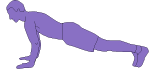
56-60 Push Ups
| If you did 56-60 push ups in the test | |||
| Day 1 – 60 seconds (or more) between sets | |||
| set 1 | 30 | ||
| set 2 | 44 | ||
| set 3 | 40 | ||
| set 4 | 40 | ||
| set 5 | max (minimum 55) | ||
| Minimum 1 Day Break | |||
| Day 2 45 seconds (or more) between sets |
Day 3 45 seconds (or more) between sets |
||
| set 1 | 22 | set 1 | 26 |
| set 2 | 22 | set 2 | 26 |
| set 3 | 27 | set 3 | 33 |
| set 4 | 27 | set 4 | 33 |
| set 5 | 24 | set 5 | 26 |
| set 6 | 23 | set 6 | 26 |
| set 7 | 18 | set 7 | 22 |
| set 8 | 18 | set 8 | 22 |
| set 9 | max (minimum 58 ) | set 9 | max (minimum 60 ) |
| Minimum 1 Day Break | Minimum 2 Day Break | ||
The Push-Up's Quiet Job in Sport
The push-up rarely gets top billing in an athlete's program, and it shouldn't. But walk into almost any team's warm-up or off-season block and you'll find it there anyway. The reason is boring and practical: it builds pressing strength and trunk stability with no equipment, it scales from a knee version to one-arm variations, and a coach can watch fifteen athletes do it at once and spot who's cutting corners. That combination is hard to beat.
Where the carryover is real
In contact and throwing sports — rugby, football, hockey, the throwing events — the push-up trains the same muscles that fire when you brace against another body or drive something away from your chest: pecs, triceps, front delts, and the whole front of the trunk holding you rigid. It is not a bench press or an Olympic lift, but it is a cheap way to build and keep that pressing base, especially in-season when heavy barbell work gets cut back.
In sports built around the shoulder — swimming, tennis, volleyball, baseball — the value shifts from raw force toward stability and shoulder-girdle endurance. Variations that make the shoulder blades work (feet elevated, rings, a slow controlled tempo) matter more here than piling on reps. Gymnasts arguably get the most out of it, because pressing your own bodyweight while holding a rigid line is close to what their sport already asks for.
What it won't do
Being honest about it: a push-up won't make you faster, won't fix your technique, and won't carry a sport that lives in the legs. A sprinter or a soccer player gets far more from what happens below the waist. Push-ups also stop challenging a trained athlete quickly — once you can rattle off forty clean reps, you're building endurance, not strength, and you have to change the leverage or add load to keep progressing. Treated as the whole plan, it's a dead end.
Why coaches keep it anyway
So the push-up survives not because it's magic but because it's reliable. It's the exercise you can program on the road, in a hotel room, on a field with no rack, for someone coming back from a layoff or a squad of a hundred. It asks for nothing and gives back a dependable base of pressing strength and trunk control. That's a modest job, and it does it every time — which is exactly why it never leaves the program.