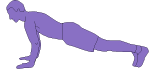
51-55 Push Ups
| If you did 51-55 push ups in the test | |||
| Day 1 – 60 seconds (or more) between sets | |||
| set 1 | 30 | ||
| set 2 | 39 | ||
| set 3 | 35 | ||
| set 4 | 35 | ||
| set 5 | max (minimum 42) | ||
| Minimum 1 Day Break | |||
| Day 2 45 seconds (or more) between sets |
Day 3 45 seconds (or more) between sets |
||
| set 1 | 20 | set 1 | 22 |
| set 2 | 20 | set 2 | 22 |
| set 3 | 23 | set 3 | 30 |
| set 4 | 23 | set 4 | 30 |
| set 5 | 20 | set 5 | 25 |
| set 6 | 18 | set 6 | 25 |
| set 7 | 18 | set 7 | 18 |
| set 8 | max (minimum 53) | set 8 | max (minimum 55) |
| Minimum 1 Day break | Minimum 2 Day Break | ||
Why Filmmakers Love the Push-Up
Give a director ninety seconds and a character who needs to change, and odds are you'll see push-ups. No dialogue, no exposition, just someone on the floor with shaking arms, refusing to stop. It's the cheapest shorthand in cinema for a person deciding to become someone else, which is why the same plain movement keeps showing up across five decades of training montages, boot camps, and comeback stories.
Nobody sold it harder than Rocky. Sylvester Stallone built an entire franchise on the idea that greatness is just ordinary effort repeated well past the point where most people quit, and the floor work in those montages is the visual proof. Decades later, Creed handed the same language to a new generation, with Adonis grinding through his own reps to build a legacy instead of inheriting one. The exercise carries the theme so no one has to say it out loud.
The military films use it differently, as pressure. In Full Metal Jacket, Stanley Kubrick turns basic training into a machine for breaking recruits down and rebuilding them, and push-ups are part of the grind that strips away the individual. An Officer and a Gentleman leans on the same drill-instructor ritual, where every rep is a test of whether you'll crack or hold. Here the movement isn't triumphant at all. It's punishment, endurance, the price of belonging.
Then there's the version that doubles as a statement. In G.I. Jane, Demi Moore's one-armed push-ups aren't just a physical feat, they're the whole argument of the film compressed into a single shot: a woman proving she can meet the hardest standard on its own terms. Mulan pulls a similar trick in animated form, using its training sequence to mark the moment the hero stops pretending and starts becoming genuinely capable. The same movement that means suffering in one film means arrival in another.
That range is exactly why the push-up endures on screen. It needs no equipment, no ring, no explanation, because anyone watching has tried it and knows precisely what it costs. So when a character drops down and starts counting, we don't need a speech about willpower. We already understand. And somewhere in that flash of recognition sits a small dare: if it works for them, maybe it's worth getting down on the floor yourself.