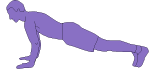
Decline Push-Ups
A decline push-up is a standard push-up with your feet raised on a box, bench, or step. Tilting your body that way shifts more of the load onto your upper chest and front delts, which makes it noticeably harder than a floor push-up. The higher your feet, the harder it gets, so you can dial the difficulty up or down just by changing the step height.
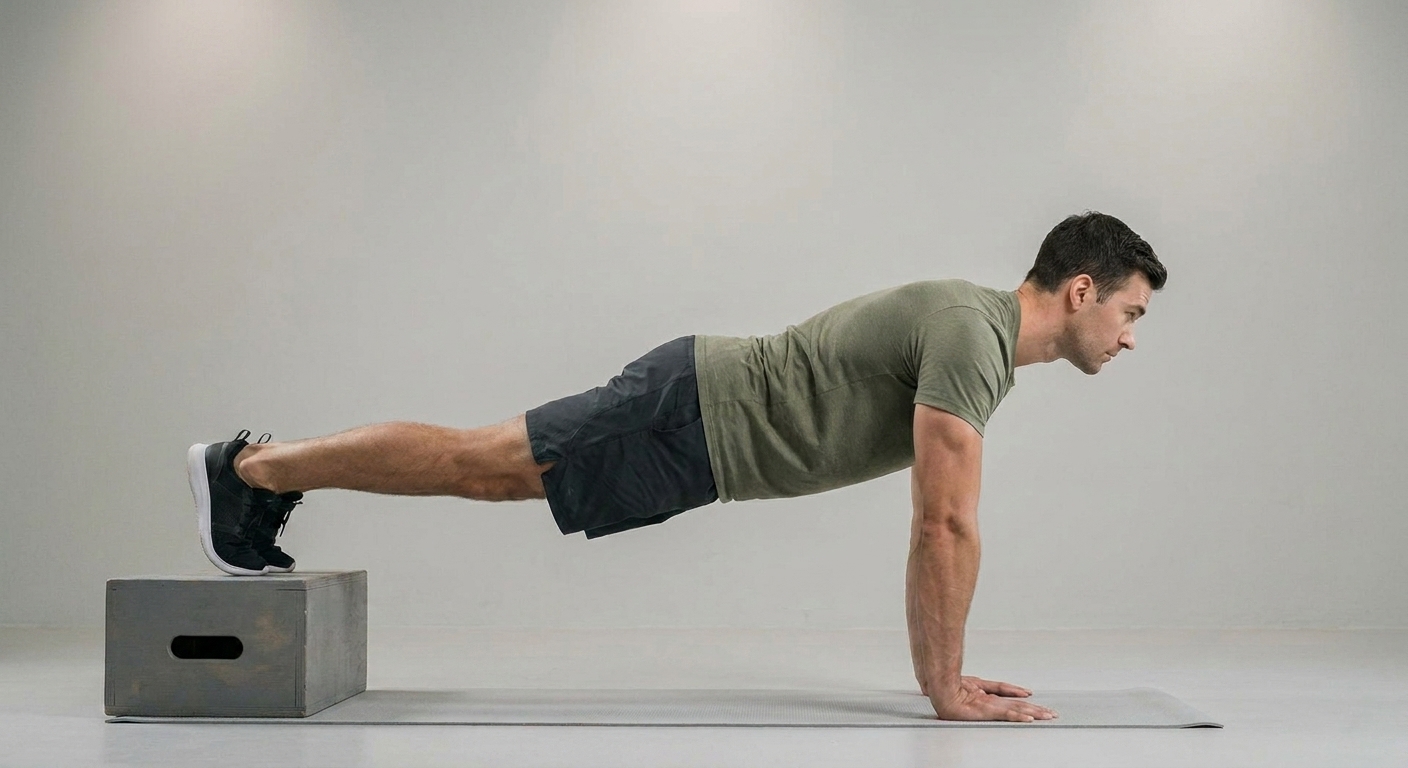
How to do a decline push-up
- Set your feet on a stable box or step. Start low, around knee height or less, until you know how it feels.
- Place your hands on the floor a little wider than your shoulders, arms straight.
- Brace your core and glutes so your body forms one straight line from heels to head.
- Bend your elbows and lower your chest toward the floor under control.
- Stop when your chest is just above the ground, then press back up until your arms are straight.
- Keep the line straight the whole time and repeat for your target reps.
Muscles worked
The decline angle puts the emphasis on the upper (clavicular) chest and the front deltoids more than a flat push-up does. Your triceps still do plenty of work extending the elbows, and your core, glutes, and shoulders fire throughout to keep the raised-feet position from sagging.
Benefits
- Targets the upper chest and front delts, which the standard push-up hits less directly.
- Scalable: raise the step to make it harder, lower it to make it easier.
- Needs no equipment beyond a sturdy step, bench, or box.
- A useful step up once floor push-ups start to feel easy.
Common mistakes
- Hips piking or sagging. Squeeze your glutes and brace your core so the body stays in one line, not a peak or a hammock.
- Feet too high, too soon. A big elevation shifts a lot of weight to your shoulders. Build up gradually.
- Head dropping. Let your chest lead. Keep a neutral neck and look at a spot on the floor slightly ahead of your hands.
- Short range. Lower until your chest nearly touches, not just a few centimetres.
Difficulty and progressions
Start with your feet low, roughly knee height, and get a clean set of full-range reps before you go higher. As you get stronger, raise the step step by step; each increase in height loads the upper chest and shoulders a little more. A reasonable aim is 3 sets of 8 to 12 solid reps at a given height, then move the feet up once that feels controlled. If a set starts to break form, lower the step rather than grinding out sloppy reps.
Explore all push-up variations, brush up on proper push-up form, or follow the full 100 push-ups programme.