Handstand Push-Ups
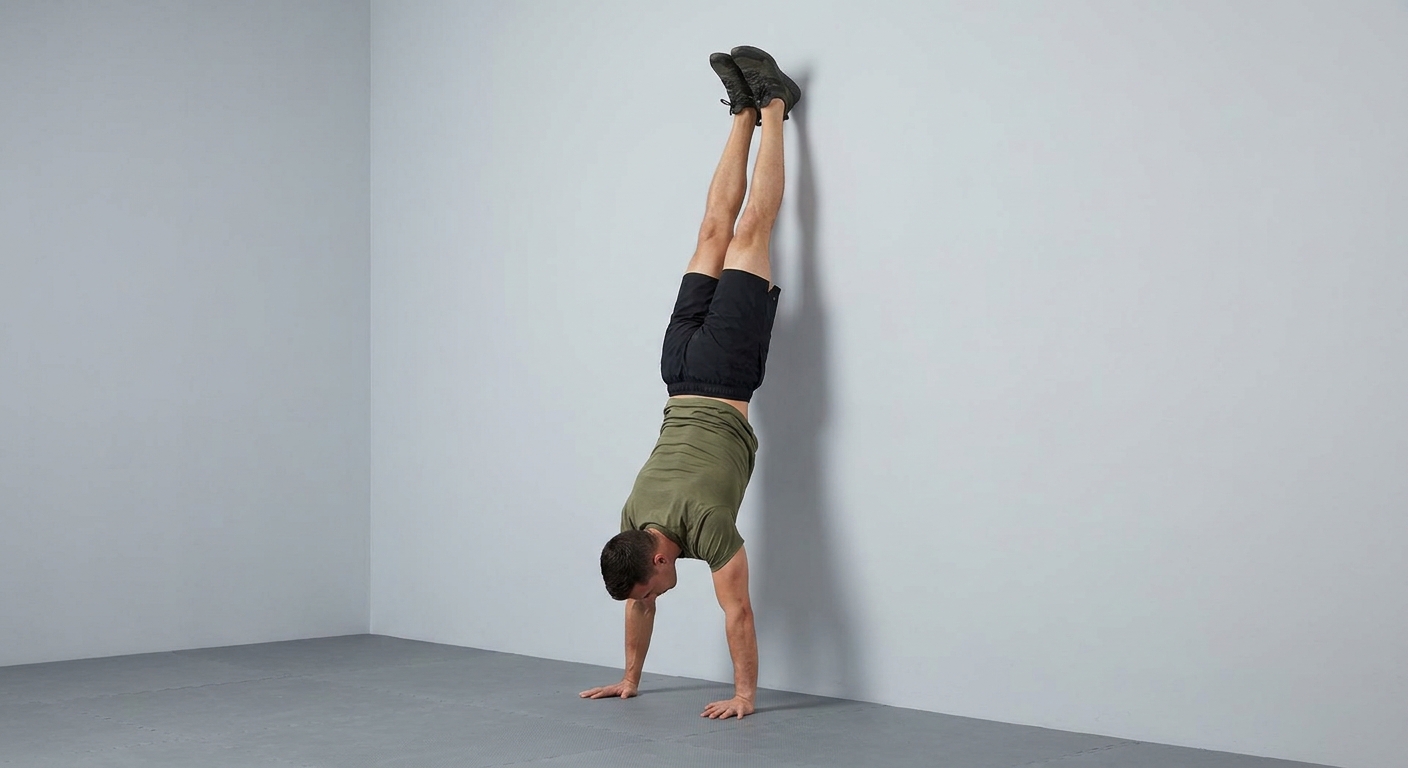
The handstand push-up is the hardest bodyweight shoulder press there is: you balance upside down with your heels resting on a wall and press your whole bodyweight overhead. It hammers the shoulders and triceps far harder than any floor push-up, and you earn it by getting strong at pike push-ups first. Against a wall it is a genuinely achievable goal, not a circus trick.
How to do a handstand push-up
- Face a wall, place your hands on the floor shoulder-width apart, roughly a hand's length from the skirting board.
- Kick one leg up and follow with the other so your heels come to rest lightly against the wall. Straighten your arms and stack your hips over your shoulders.
- Brace your core, tuck your chin slightly, and bend your elbows to lower the top of your head toward the floor under control.
- Stop just before your head touches, then press hard back up to straight arms.
- Breathe out on the way up. Come down feet-first the moment you feel your balance go.
Safety cue: use a wall as a backstop, keep the landing area clear, and practise a controlled feet-first dismount before attempting full repetitions. If your balance shifts, stop the set and come down immediately.
Muscles worked
The handstand push-up is a shoulder-dominant lift. The main movers are:
- Shoulders (deltoids) - the primary driver, working through a full overhead press.
- Triceps - straighten the elbows to lock you out at the top.
- Upper back and traps - stabilise the shoulder blades and hold the position.
- Core - keeps your body in one rigid line so you do not banana or tip over.
Benefits
It gives you a heavy vertical pressing movement with no equipment at all - just a patch of wall. Pressing your own bodyweight overhead builds strong, capable shoulders and rock-solid lockout strength in the triceps. Balancing upside down also trains coordination and full-body tension that carries straight over to other calisthenics skills.
Common mistakes
- Arching the lower back. Squeeze your glutes and ribs down so the body stays in a straight line instead of an arch.
- Flaring the elbows. Let them travel back and slightly out, not straight out to the sides, to keep the shoulders safe and strong.
- Half range. A tiny dip is not a rep - lower until your head nearly touches the floor.
- No wall. Free-standing handstand push-ups are an advanced skill. Use a wall until the strength is genuinely there.
Prerequisites & how to progress to it
Get strong at pike push-ups first - they train the same overhead angle without the balance demand. Aim for a comfortable set of 10 to 15 with your hips high before going upside down. From there, build up in stages:
- Wall walk-ups. Start in a push-up, walk your feet up the wall and your hands toward it to get used to bearing weight overhead.
- Partial range. Hold a wall handstand and lower a few inches, then press back up. Add depth as you get stronger.
- Full range. Lower the head all the way to the floor and press back to a full lockout.
Progress one step at a time and only add range when the previous stage feels solid.
Explore all push-up variations, brush up on proper push-up form, or start the full 100 push-ups programme.