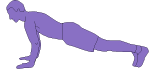
Knuckle Push-Ups
A knuckle push-up is a standard push-up done on your fists instead of your palms, so the wrist stays neutral and straight in line with the forearm. Many people find this more comfortable than bending the wrist back on flat hands, and the style is popular in boxing, karate, and other martial arts. Because your fists lift the shoulders a little higher off the floor, you also get a slightly larger range of motion at the bottom.
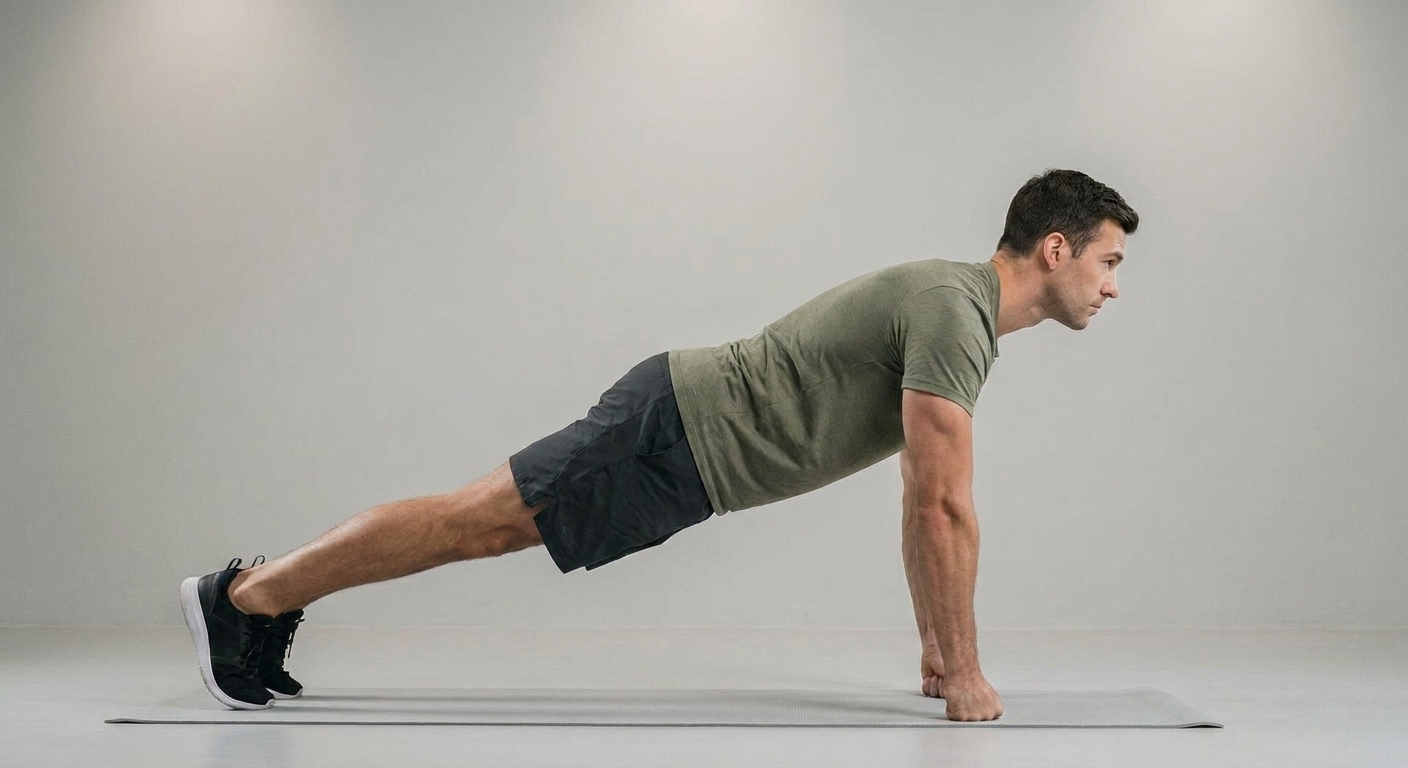
How to do a knuckle push-up
- Make two firm fists and place them on the floor about shoulder-width apart.
- Load the weight onto your first two knuckles (the index and middle finger), not the smaller ones.
- Keep each wrist straight and in a solid line with your forearm - do not let it bend or roll.
- Set your fists on a mat, folded towel, or other soft surface to protect the knuckles.
- Hold your body in a straight line from head to heels, with your core braced.
- Lower your chest towards the floor, then press back up until your arms are straight.
Muscles worked
Knuckle push-ups train the same muscles as a standard push-up: the chest (pectorals), the fronts of the shoulders (anterior deltoids), and the triceps do most of the pressing work. Your core, including the abs and lower back, works to keep the body rigid, while the forearms and wrist muscles stay active to hold the fists steady.
Benefits
- Neutral wrist position. The wrist stays straight rather than extended, which many people find more comfortable, especially if flat-hand push-ups feel awkward.
- Martial-arts carryover. Pressing on your fists mirrors the striking surface used in boxing and many martial arts, so it is a familiar position for fighters.
- Slightly deeper range. Raising your hands onto your fists lets your chest travel a little lower, giving a slightly deeper stretch at the bottom of each rep.
Common mistakes
- Bending the wrist. Letting the wrist sag or fold defeats the point - keep it stacked straight over the forearm.
- Training on a hard floor with no padding. Bare knuckles on tile or concrete can bruise; use a mat or towel.
- Rolling onto the little-finger knuckles. Keep the weight on the first two knuckles so the fist stays stable and even.
Difficulty & progressions
Knuckle push-ups are close in difficulty to a standard push-up, with a bit of extra demand on wrist and forearm stability. If they feel tough at first, do them on your knees or against a raised surface, then move to the floor. Once full reps feel easy, slow the lowering phase, add pauses at the bottom, or work towards harder push-up variations.
Explore all push-up variations, review proper push-up form, or start the 100 push-ups programme.