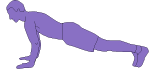
T Push-Ups (Rotational Push-Ups)
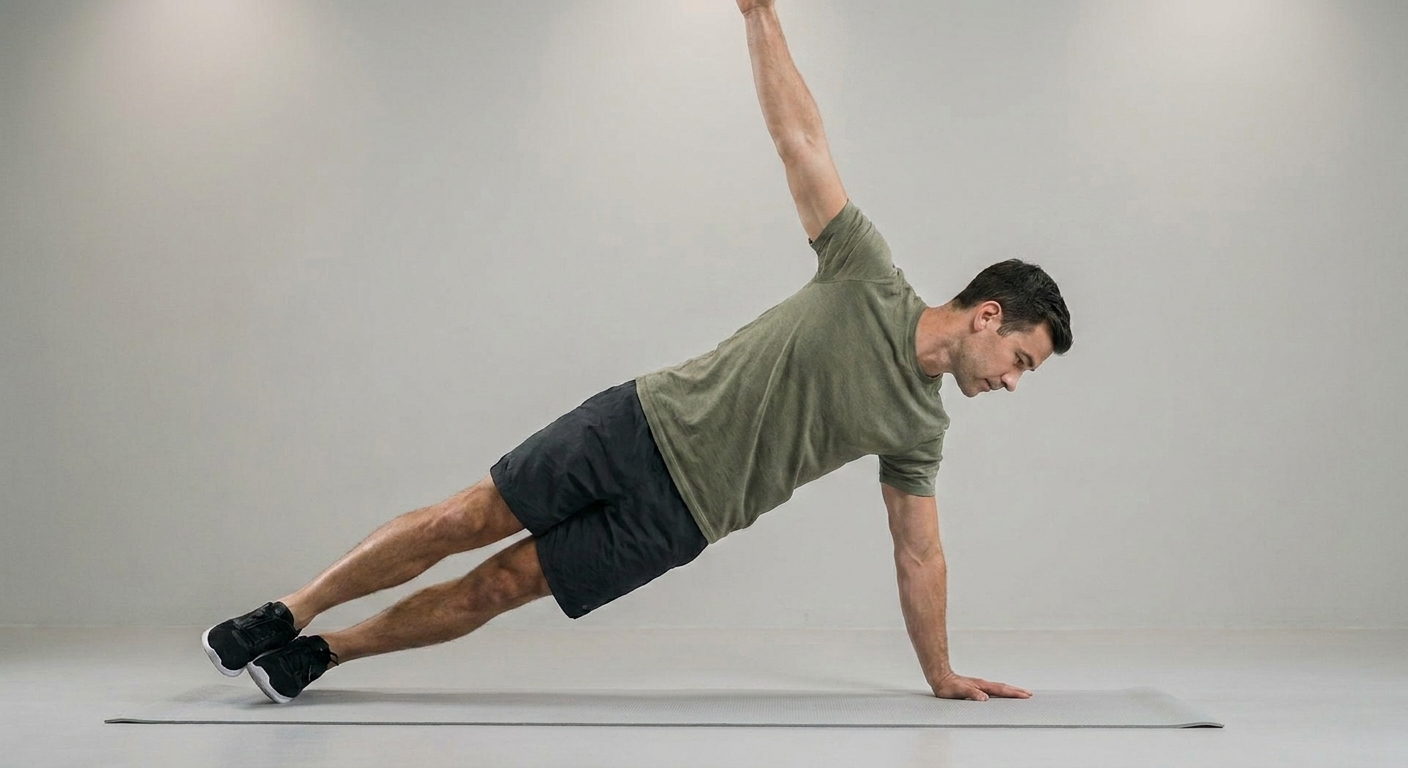
A T push-up is a standard push-up followed by a rotation into a side plank: you press up, then twist to one side and reach your top arm straight toward the ceiling so your body forms the shape of a "T". It trains everything a normal push-up does, then adds work for your obliques, shoulder stability and thoracic (upper-back) rotation. Because you rotate to a new side on each rep, one T push-up asks more of your core and balance than a plain one.
How to do a T push-up
- Start in a push-up position: hands under your shoulders, body in a straight line from head to heels, feet about hip-width apart.
- Bend your elbows and lower your chest toward the floor, then press back up like a normal push-up.
- At the top, shift your weight onto your left hand and roll onto the outer edge of your left foot.
- Rotate your chest open to the right and reach your right arm straight up to the ceiling, forming a "T". Look up at your top hand if it feels comfortable.
- Hold for a moment with your hips lifted and your shoulders stacked, one over the other.
- Rotate back down, place your right hand on the floor, and do another push-up.
- This time rotate to the left. Keep alternating sides with each push-up.
Muscles worked
The push-up portion works your chest, triceps and the front of your shoulders. The rotation adds your obliques and deep core, which resist twisting and keep your hips up. Your shoulders and upper back also work hard to stabilise your body as your weight shifts onto one arm, and the reach opens up your thoracic spine.
Benefits
T push-ups pack pushing strength and rotational core work into one move, so you get more out of each rep when time is short. The side-plank position challenges your balance and teaches your shoulders to stay stable under load. The reach also builds mobility through the upper back and chest, which many people lose from sitting. Because they demand control, they carry over well to sports and everyday twisting and reaching.
Common mistakes
- Hips sagging in the rotation. Squeeze your glutes and lift your hips so your body stays in one line from head to feet, not drooping toward the floor.
- Rushing the reps. Speeding through kills the balance and control that make this exercise worthwhile. Move at a steady pace and pause at the top of each rotation.
- Not stacking your shoulders. Your top shoulder should sit directly above the bottom one. Twisting only halfway keeps the load off the muscles you're trying to train.
- Letting the top arm drift. Reach straight up, not forward or back, and follow the hand with your eyes to keep your spine long.
Difficulty & progressions
T push-ups are harder than standard push-ups because of the balance and core demand. To make them easier, drop to your knees for the push-up part, or skip the push-up entirely and just practise the rotation from a plank until it feels stable. To make them harder, slow the tempo and add a longer hold at the top of each "T".
Optionally, once the bodyweight version feels solid, you can hold a light dumbbell in the reaching hand and press it up as you rotate. Add weight only when your form stays clean without it.
Explore all push-up variations, brush up on proper push-up form, or start the full 100 push-ups programme.