Dive Bomber Push-Ups
The dive bomber push-up is a flowing, full-range push-up: you start hips-high in an inverted V, swoop your chest down and forward until it skims close to the floor, press up into an upward-dog position, then reverse along the same arc back to the start. That travelling path is what makes it work your shoulders, chest and triceps while opening up mobility through the spine and hips.
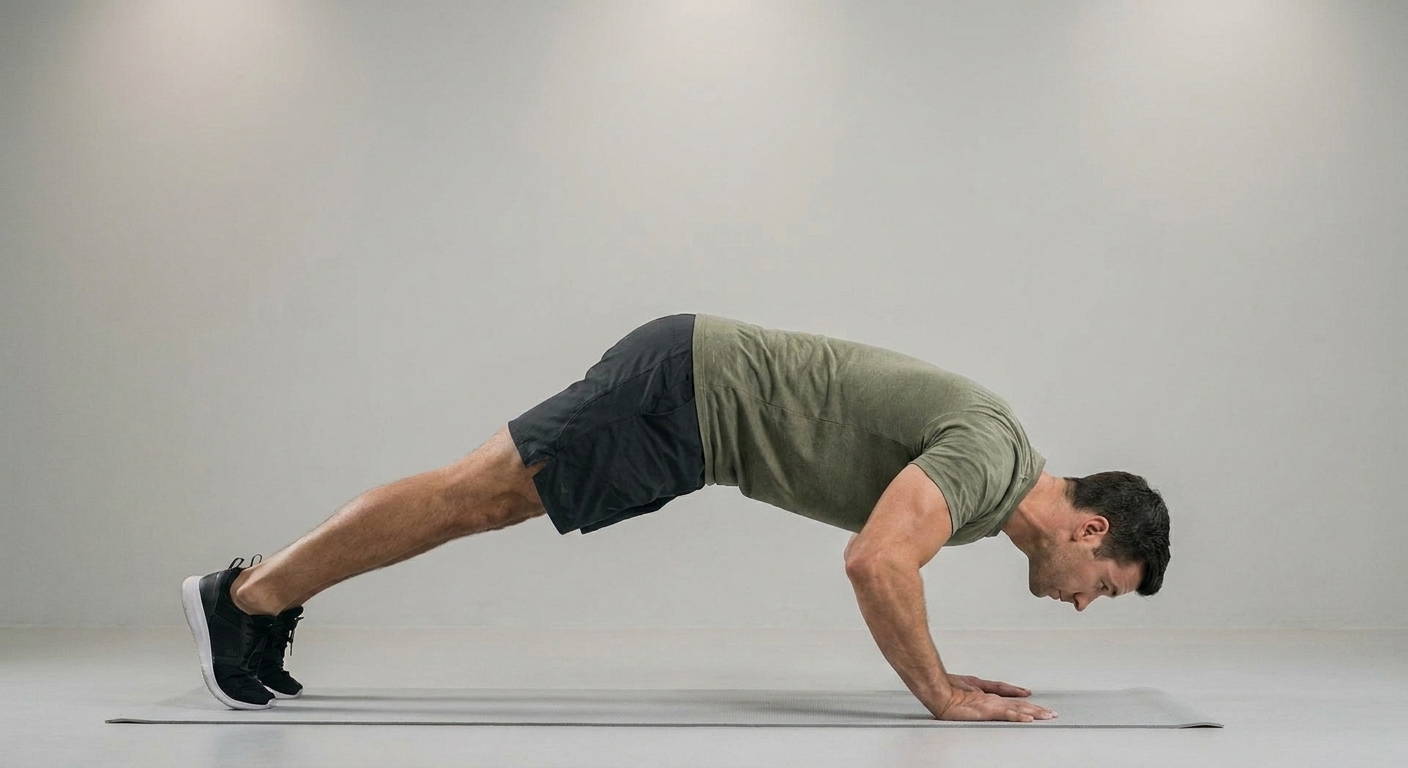
How to do a dive bomber push-up
- Start hips-high in an inverted V (downward-dog shape): hands a little wider than your shoulders, feet planted, straight legs, head between your arms.
- Bend your elbows and swoop your chest down and forward, tracing an arc so your chest passes low and close to the floor.
- Continue forward until your hips sink toward the ground and your chest lifts into an upward-dog position, arms straightening, gaze forward.
- Reverse the movement: push back and up along the same arc, lifting your hips until you return to the inverted V.
- Move smoothly and keep breathing. That full down-and-back cycle is one rep.
Muscles worked
The press through the bottom loads the front of the shoulders (deltoids), the chest (pectorals) and the triceps. Because you travel through such a long range, you also demand mobility from the upper back and spine and the hips and hamstrings, and the core stays engaged to control the arc from start to finish.
Benefits
- Builds pressing strength through a much longer range than a standard push-up.
- Trains shoulders, chest and triceps together in one continuous movement.
- Opens mobility through the shoulders, spine and hips as you flow between the two positions.
- Needs no equipment and can be done anywhere you have floor space.
Common mistakes
- Cutting the range short. Keep the chest travelling low and close to the floor rather than dipping halfway and popping back up.
- Dropping the hips at the wrong moment. Your hips should only sink once your chest has swooped forward, not while you are still coming down.
- Rushing. Speeding through the arc turns it into a bounce. Control both the way down and the way back.
- Flaring the elbows wide. Let them track back at a comfortable angle so the shoulders stay in a strong position.
Difficulty & progressions
The dive bomber is harder than a standard push-up because of the range and the shoulder load. If the full movement is too much, start by holding the inverted V and practising a slow downward-dog to upward-dog transition without the low chest pass. Elevating your hands on a bench or step also reduces the load while you learn the arc. When it feels smooth, work toward a full, controlled range on the floor, then add reps. Once you can string together clean sets, you have a strong tool to fold into your regular training.
Dive bomber vs Hindu push-up
The two look almost identical on the way down, and the dive bomber is closely related to the Hindu push-ups (dands). The difference is the return: in a Hindu push-up you push straight back to the starting V from upward dog, whereas in a dive bomber you retrace the same arc in reverse, so your chest sweeps low again on the way back. That extra pass makes the dive bomber more demanding through the bottom.
Ready for more? Explore all push-up variations, dial in your proper push-up form, or follow the full 100 push-ups programme.