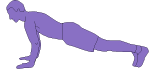
Hindu Push-Ups (Dands)
The Hindu push-up (dand, दंड) is a flowing, full-body push-up that moves through a continuous arc instead of a single up-and-down rep. It comes from India's traditional physical culture, where wrestlers have long trained dands in the akhara (wrestling gym) as part of their bodyweight conditioning for kushti. One rep sweeps you from a hips-high inverted V, down and forward close to the floor, and up into a chest-open stretch, working strength and mobility in the same motion.
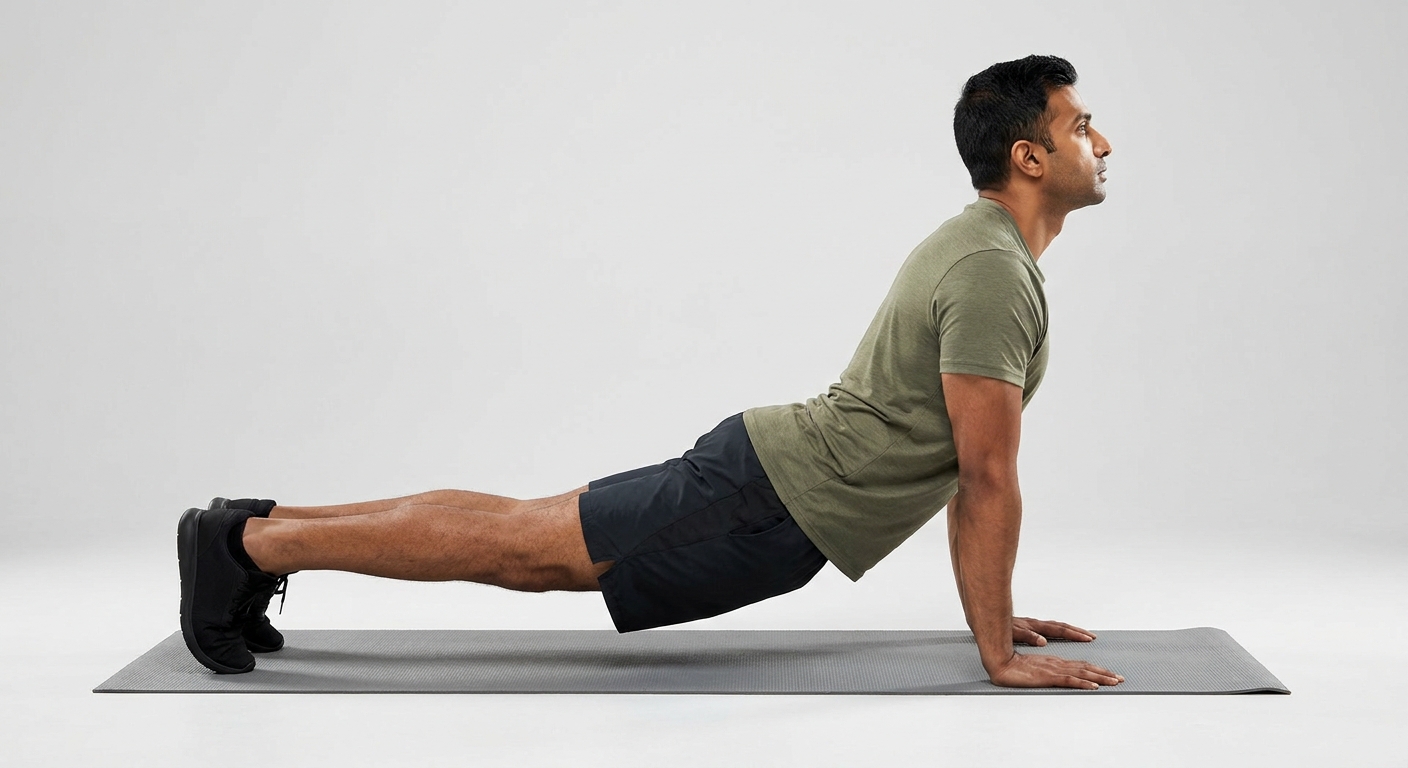
How to do a Hindu push-up (dand)
- Start in a downward-dog position: hands and feet on the floor, hips pushed high, body forming an inverted V.
- Bend your arms and swoop your chest down toward the floor, then forward, skimming close to the ground as you move.
- Continue the motion into an upward-dog: hips low and close to the floor, arms straightening, chest lifted and open, eyes forward.
- Push your hips back and up to return to the starting V. That is one rep. Keep the movement smooth and connected.
Muscles worked
Dands train the shoulders, chest, and triceps through the pushing phase, while the back and core work to control the arc and hold your body stable through the transition. Because you flow through a large range of motion rather than a fixed plane, they also demand and build mobility in the shoulders, spine, and hips. The legs stay engaged throughout to drive the hips up and back at the top of each rep.
Benefits
- A full-body movement that combines pushing strength with mobility in one rep.
- No equipment needed, just floor space.
- Opens the chest, shoulders, and spine as you move through the arc.
- A traditional conditioning exercise that scales well to higher repetitions.
Common mistakes
- Rushing the arc. The value is in the smooth sweep. Move with control instead of throwing yourself through the rep.
- Short range of motion. Bring the chest genuinely low and forward, and reach a full upward-dog. A shallow arc misses the point.
- Dropping the hips too early. Keep the hips high until your chest has swept forward, then lower into the upward-dog. Sagging early strains the lower back.
Dand in Indian physical culture
The dand is a staple of traditional Indian wrestling and akhara training, where it has been used for generations as bodyweight conditioning. Wrestlers often perform dands in high volume, building up to large numbers of reps as part of their daily practice. It remains one of the most recognisable exercises in India's home-grown strength tradition.
Difficulty & progressions
If the full arc is hard on your shoulders, start with a smaller range and fewer reps, and let your mobility catch up over time. Beginners can practise the downward-dog and upward-dog positions on their own first, then link them together slowly. As you get comfortable, lengthen the sweep and add reps gradually. Once the movement feels smooth, work toward longer sets the way it is trained traditionally, and use dands as a warm-up or as their own conditioning session.
Explore all push-up variations, try the closely related dive bomber push-ups (a very similar arc, but you return the way you came), or follow the full 100 push-ups programme.